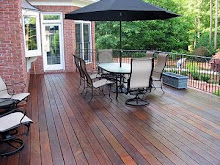
If you think that you want full length boards to avoid seams between the ends of your boards, you may want to consider some other options. Maybe it’s the rot on the ends of the boards you noticed when you took apart your old pressure treated (PT) deck that you’re trying to avoid on your new deck design.
Premium hardwood ipe’, cumaru, garapa, jatoba, massaranduba and tigerwood decking is very hard and will NOT rot. Sealing the ends of the boards with wax emulsion during construction prevents end checking (cracking) too. So, seams between the ends of boards will not result in the rot that occurs on PT decks.
Getting past the concern about boards rotting on the ends allows for some interesting deck design and money saving opportunities. You can save money designing your deck allowing seams because fewer long boards 12’ and longer are milled and imported than shorter boards. By mixing your lengths with as little as one third of your lengths less than 12’, you can save up to 20% on the cost of your boards. I know that got your attention.
Borders and angled layouts are popular design features but other layouts can provide interesting deck designs leaving no seams without paying extra for long boards. This first design using different species of decking nicely breaks up a long deck that might otherwise look like a bowling alley. The 2nd design also uses different species and shorter boards in the middle. The section in the middle can be moved to the border to accent a doorway too.


You can also make your decking look like plank flooring by easing the ends of your deck boards. This is done by quickly rounding over the top edge of the ends to match the already eased edges as you install them. This actually accents the end joints and makes them match the edges. Here are two photos of beautiful jobs done by
Atlanta contractor using eased ends.


While cumaru
rosa, tigerwood, massaranduba and garapa are very consistent in color from board to board, ipe’ boards have more variety. If you install full length boards with a lot of variety, you may cause a “striped” effect. This is easily broken up using eased edges with board joints. This is especially noticeable on smaller or T&G decks. A damaged edge on a board leads to the loss of the entire board on decks designed with full length boards while decks with planned seams can easily use them by cutting out the damaged section. The ends of the boards in the photo below have been eased to match the edges of the divider board. They go together much better than if the square end butted up to the eased edge.

Use seams to enhance the beauty of your deck, create interesting deck designs, utilize hardwoods more responsibly and SAVE MONEY when building your hardwood deck. All of the comments and suggestions here focus on the use of ipe’, cumaru, massaranduba, garapa and tigerwood decking and don’t apply to composite and PT decking.
This compilation of feedback from contractors and professional experience was provided by
Brazilian Wood Depot.


 You can also make your decking look like plank flooring by easing the ends of your deck boards. This is done by quickly rounding over the top edge of the ends to match the already eased edges as you install them. This actually accents the end joints and makes them match the edges. Here are two photos of beautiful jobs done by
 While cumaru