Tuesday, November 4, 2008

Flood Company's Premium Deck Oil Finish


Best Deck Oil Finish for Ipe and other Brazilian Decking

The finale to a beautiful Ipe or other Brazilian deck is the finish . . . hence the name. Good deck oil brings out the natural beauty of Ipe and Brazilian decking and helps protect against UV rays thereby preserving the natural color. Some premium deck oils are tinted red or brown to enhance the natural color. Deck oils formulated for cedar, cypress and pine do not provide the same finish on Brazilian decking. Since Brazilian decking is so dense, you must use deck oil that penetrates the wood well. Messmers, Cabot, and Penofin are good deck oils however, in our independent testing we have experienced superior results and greatly increased longevity with deck oil manufactured by Flood Company. Flood premium deck oil is water borne and contains emulsified oil and acrylic. It penetrates the decking better than any other product and leaves a natural finish, which lasts at least four times longer than any other product.


Better Color Preservation


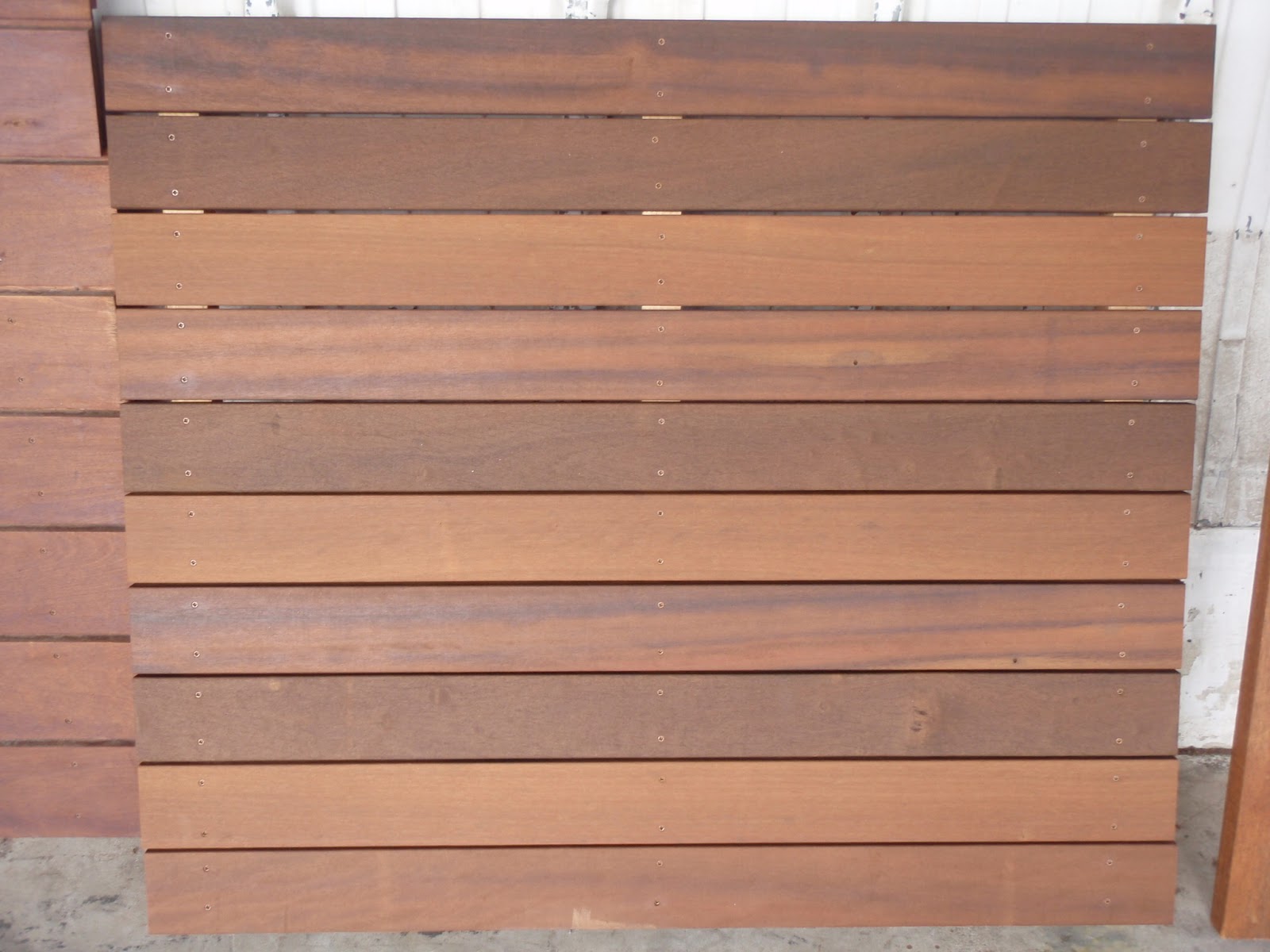
Ten weeks before this photo was taken, the boards were oiled with Penofin (the best of the comparable deck oils) on the left side, one coat of Flood oil in the middle and two coats of Flood oil on the right side. The Flood oil protected the wood so well that it prevented the natural darkening in sunlight that occurs on jatoba, tatajuba, tigerwood, garapa and cumaru boards. If these darker colors are desired, you must allow for the colors to change before applying this oil. Otherwise, you won’t see the color change until the deck oil begins to wear off. We recommend red or brown oils for some species so that the wood’s natural color displays more quickly.


Deck Oil Color Choices


We oiled all of these boards with two coats of Flood deck oil. Red oil was applied on the left sections, natural in the middle and brown on the right. The red oil brought out the natural red color in Cumaru, Jatoba and Tigerwood while appearing orange when applied to the freshly milled golden color of tatajuba and garapa. Both of these woods oxidize to dark brown and honey brown respectively but this transformation would be delayed because of the protective seal that Flood oil provides. The brown oil looked good on Garapa, Tatajuba, Sucupira and Ipe’. Notice that we’ve displayed a 2nd Tatajuba board on the bottom that was oiled immediately without allowing time for the board to oxidize in the sun and turn brown. After installing your deck, you can wait to oil your deck after the preferred color change occurs. Jatoba, Tigerwood and Cumaru become darker red while Tatajuba and Garapa brown.

Deck Finish Preparation

Opening up and removing any blockage from the pores of the wood before oiling greatly improves the effectiveness of the finish.

ON NEW DECKS where there has not been any finish previously applied, Flood Company’s stripper should be applied to open up the pores. It is easy to mix this stripper with water, spray, soak 20 minutes, agitate, rinse off, allow deck to dry over night and apply TWO COATS of Flood deck oil. The 2nd coat must be applied within 4 hours of the first coat. The temperature must be above 50 degrees.


On decks that have been previously finished with a finish other than Flood, you must first use the stripper to remove the old finish, use Flood Cleaner Brightener to remove the stripper / finish residue and then oil deck (two coats) after allowing deck to dry over night.

On decks that have been previously finished with Flood deck oil, it is best to mix and spray on Flood Cleaner Brightener, soak for 20 minutes, agitate and rinse clean. Allow deck to dry over night and finish with two coats of Flood deck oil.

These 3 methods are all really only 2 steps because the stripping and cleaning can be done right after each other and both chores are more spraying than scrubbing. So, the process is not cumbersome. Considering that the extra step provides a finish which lasts at least FOUR TIMES LONGER than any other finish, it is certainly worth the trouble to perform the extra step.

Sunday, August 24, 2008

Aluminum Hidden Deck Clip Installation

Face Screwed deck installation is preferred over nails because they simply hold better. In addition, you can choose stainless steel screws, which will not stain your beautiful decking. Stainless steel nails are only (easily) available in finish nails because SS nails are too soft to use for most applications.

Hidden Fastener Deck Clips are often chosen by customers who don't want to see the heads of the screws in the face of their deck boards. To use these, the boards must be kerfed (grooved) on the sides so that the clips can be inserted into the boards.

The Ipe Clip Extreme is an effective product made of stainless steel covered with plastic to blend in with the wood color. This ipe clip is installed by driving a screw through the hole in the clip at a 45 degree angle and through the board thereby holding the board from moving as the board shrinks slightly. Most installers find it easier to pre-drill a hole in the board so that they can drive the screw more easily. This pre-drilling to install the ipe clip is an extra step that some prefer to avoid.


Aluminum Deck Clips are preferred by some installers because pre-drilling is not necessary. These deck clips are durable and hold well but the boards may shift as they shrink because the screws are not driven down through the board. The screws are driven straight down through the clips between the boards.


Using All Weather Sub Floor Adhesive solves this problem. The installation procedure for these aluminum deck clips is shown here.


Run a bead of adhesive down the top of the joists where you are beginning your deck installation. Apply enough to accommodate your first two or three boards.


Install your deck clips along the entire edge of the first board with a clip on each joist. The screw must be run down until the top of the screw is level with the clip. Do not tighten it down because this will tilt the free edge of the clip down thereby preventing you from slipping the 2nd board into place.


Once you've installed clips on every joist along the edge of the first board, slip the leading edge of the 2nd board into the clips snuggly.


Now, install the clips into the 2nd edge of the 2nd board on every joist making sure that you only drive the screw down until it is level with the clip. Do not screw it down too tightly.
Once this 2nd clip is installed on the 2nd board, go back to the nearest clip between the two boards and tighten it down firmly. Now, the clip will press the boards down on the glue and sufficiently seat them permanently.

Repeat this procedure to complete your deck.

A different installation technique must used for the first board edge (often against the house), the last edge (away from the house), the steps and risers because there is no joist to screw into or you cannot access the edge of the board.
Plugs that match your deck species are a very good option but the installation is tedious and they don't leave any option to replace boards later if that need arises.
Hidden Brackets that screw to the the joists and to the under side of deck boards are a good option. They install easily and can be used on these few areas where the deck clips simply don't apply well.

There you go . . . hidden deck fasteners.

Courtesy Brazilian Wood Depot.


Copyright ©


Wednesday, August 6, 2008

Forest Preservation

Rules Of Forest Preservation for Brazil and other lumber producing countries are designed to preserve their natural resources and the environment. CITES (the Convention on International Trade in Endangered Species of Wild Fauna and Flora) is an international agreement between governments. Its aim is to ensure that international trade in specimens of wild animals and plants does not threaten their survival. This is a vitally respected agreement boasting 173 member nations at this time. It was drafted in 1973 and provides the framework to be respected by each Party (member country), which has to adopt its own domestic legislation to ensure that CITES is implemented at the national level. The Brazilian government has had these laws in place for decades to ensure the regeneration of lumber that is harvested there from their forests. This CITES Treaty is the agreement protecting our flora and fauna worldwide and NOT any other private entity claiming to do so . . . at a profit.

The Forestry Stewardship Council (FSC) is a pay to join organization with its main office in Mexico. The FSC organizes loggers, mills, shippers and distributors to join and charge fees for certifying that certain lumber is harvested responsibly. This is a self-regulated organization without a specific fee structure, the FSC is not regulated by any government body and they are not required to submit to audits of where the trees they certify came from. FSC certified shipments of lumber are readily available to importers who wish to buy them.

Tree Harvest Certifications (issued by Ibama � the Federal authority) must accompany ALL timber and lumber from standing timber in Brazil all the way to the importer's warehouse in the United States. This includes origin and species certifications as well as fumigation, density and grade specifications. To acquire these certifications, the loggers and mills must first present certifications provided by the Brazilian government which allow them to harvest particular trees. These harvest certifications must be carried by the loggers and the tree transport truckers at all times. Being caught without them will cause their logs and trucks to be confiscated and they will be jailed as poachers.

Rain Forest Preservation - The largest cause of loss of forest lands in the Rain Forest Basin is burning to create farmland and pasture land. To maintain the Rain Forests for future generations it is important to bring value to the standing forest. The responsible use of the select cut techniques (required in Brazil today) on a broad range of species will help preserve the Amazon for future generations by allowing local people to make a living in the rain forest rather than destroying it for the raising of cattle and soybeans. People do not destroy that which sustains them. By introducing the use of more species for a purpose, the use of these trees is spread over a variety of species. This prevents the over use of any one species. Brazilian Wood Depot offers a wider variety of species for decking than any distributor in the United States. The availability of more choices spreads demand among those choices.
Few people grasp the immense size of the Amazon rain forest. It is roughly the size of the continental United States. Today about 15% of the total Amazon rain forest is deforested. When Europeans arrived in South America, about 15 % of the rain forest was deforested.
In 1990, a number of tropical forestry experts met to discuss the causes of tropical deforestation and what could be done to slow deforestation. They arrived at a number of conclusions, some of which are summarized below (Smithsonian Institution/International Hardwood Products Association, 1990):

• Tropical rain forests will be preserved only if they are accorded economic value.
• Blanket bans and embargoes on tropical hardwood will tend to depress the value of these hardwoods and the forests that contain them. Such constraints generally diminish the economic incentives to conserve and manage these forests in the face of alternative land uses that lead to their destruction.
• In areas where prices received for timber do not fully cover the cost of forest management; there is a lack of incentive and commitment to forest management.
• Funds obtained from products of the tropical forests must be re-channeled into managing and regenerating those forests.
• The international tropical timber industry should encourage the continued establishment of conservation areas solely dedicated to forest preservation

Many of these ideals are addressed in the CITES Treaty mentioned earlier in this article. The destruction of tropical rain forests is due to growing population, growing infrastructure, and the economic activities associated with certain occupations. Unless people who work in cattle ranching, farming, charcoal production, and gold or oil exploration can find an alternative source of income that preserves that income's resources, their income will drop due to loss of resources and their country's subsequent economic development will suffer.

Courtesy Brazilian Wood Depot

Tuesday, August 5, 2008

Deck Board Thickness And Strength

The Ideal Deck Board Thickness depends on the hardness and bending strength of the material. Pressure treated (PT) pine and cypress, composite and redwood are readily available in 5/4 x 6” boards because this is the thickness needed for building strong decks with joists that are 16” apart – on center (O.C), an industry standard. Cedar is available in 5/4 x 6 and also 2 x 6 boards. Cedar is quite a bit softer than the others mentioned. So some folks want a thicker board. None of these boards are purchased in 1 x 6 dimensions as deck boards because they simply would not be firm enough to build a deck the doesn’t flex.

Brazilian Deck Boards, on the other hand, are most often sold in 1 x 6 dimensions. Brazilian deck boards are six to ten times harder than cedar and three to four times harder the PT and composite material. So, it is understandable that Brazilian ipe decking boards are much firmer than any other commonly available deck material even when they are 75% as thick as most other deck boards. Folks first comparing the attributes of Brazilian ipe decking boards to other materials available often price 5/4 x 6 lumber but this is not a good performance comparison. 1 x 6 Brazilian ipe decking boards are firmer, last longer and build a stronger deck than every other commonly used deck material. A lumber importer that is commonly asked about this comparison made this video, which clearly depicts the strength comparison between Brazilian ipe decking 5/4 and 4/4 thick boards:

http://blip.tv/file/378643 His conclusion from this study is that the difference in deflection between a 1 x 6 deck board and a 5/4 x 6 board is only 1 mm or 1/24th”. This is a 300 pound man standing on only ONE board. Because of the size of his footprint, this man would normally be standing on at least two boards. This minor deflection emphasizes the fact that 1 x 6 dimensions for Brazilian ipe decking boards is ample.

Joist Spans can be adjusted to add more strength and reduce flex on a deck. Adding a few extra joists to make the joist spans 12” rather than 16” adds quite a bit of strength and firmness to a deck – MUCH more than using 5/4 x 6 boards. Adding more joists also costs a lot less money than paying for thicker Brazilian ipe decking boards. Adding joists to make smaller joist spans does NOT make all decks firmer. Composite decking material manufactured with plastic and no wood fillers sags between the joists over time no matter how close the joist spans are. The sag is reduced but they still sag. Reducing joist spans for PT and cedar decks will improve the firmness of the deck but will not increase the life of the decking, which is the weaker attribute.

Courtesy Brazilian Wood Depot

Wednesday, July 30, 2008

Best Decking Fasteners

Galvanized Nails are the most common choice for fastening pressure treated pine and cypress decking. These nails must have a coating guaranteed not to rot from the corrosive chemicals pumped into these boards meant to help fight rot and insects. As the Pressure treating industry changes chemicals to improve results, standards change to fight the changing corrosive properties that are introduced to the boards. This process has proven to be a game of “wait and see” if the nail coatings withstand the chemicals and prevent the nails from rotting.

Stainless Steel Screws are favored over nails because they do not rot or stain the wood and the threaded mechanics of screws offer much better holding power than nails. Galvanized nails are cheaper but stainless steel screws are worth the investment for a long lasting deck. Stainless Steel screws are not as hard as coated steel screws. Therefore, holes for these screws must be pre-drilled when installing superior hardwood decking products like Ipe (cumaru, tigerwood, Brazilian cherry and other) Brazilian decking choices and even composite decking. Smart-Bit by Starborn Industries is a drill bit that drills the perfect hole and counter-sink in one motion. Headcote SS screws have powder coat painted heads that virtually disappear when used on ipe, cumaru, tigerwood, Brazilian cherry and several other Brazilian decking species. GRK makes a SS trim head screw that also counter sinks nicely out of view because the BB sized head is so tiny. Ipe decking is so hard that even this small head can not be pulled through the boards.

Coated Steel Screws have the superior holding power over nails, cost less than stainless steel screws AND can actually be installed without the need to pre-drill holes. Many prefer to create a pilot hole when installing very hard ipe and cumaru Brazilian decking, which makes it easier to start the screw but the strength of these screws is still a handy attribute. GRK makes the same trim head screw in a coated steel screw, which counter sinks nicely out of view. These screws are still coated steel, which leaves the possibility of rust stains in the future.

Hidden Deck Fasteners like Ipe Clip and Deck Clip are also very popular because your deck can be constructed without any screws on the face of the boards. The screws are visible as you look down between the cracks in the boards but hidden deck fasteners are far LESS visible than face screwed boards. The Ipe Clip Extreme is a plastic coated stainless steel clip that slips into slots cut into the sides of deck boards. The stainless steel is an optimum material (over solid plastic clips) for hidden deck fasteners and the plastic coating covers the potential shine of stainless steel between the boards. The Deck Clip, made of aluminum and painted black is another favorite when installing premium ipe Brazilian decking. The thick aluminum is strong to last a lifetime and the black color (also on the screw heads) helps the clips disappear between boards. Ipe Clip Extreme screws are driven at a 45 degree angle and screw through one of the deck boards after going through the clip. The Deck Clip is driven straight down and does not penetrate either deck board that it holds. Therefore, the Ipe Clip Extreme will hold boards in place as they expand and contract and maintain uniform distance between boards after installation. The Deck Clip offers the advantage that you don’t need to run the screws through the deck boards, which negates the need to pre-drill. This is a time saving advantage. The aluminum clip should not be used in areas near salt water but hold up just fine for inland applications. Hidden deck fasteners made of 100% plastic do not hold up to weather and wear as well as these stainless steel and aluminum clips AND some of the plastic clips engineered for plastic on plastic contact squeak. This is a never-ending annoyance.

Hidden Fasteners Under Deck are also popular. Deckmaster makes a hidden deck fastening system that is mounted beneath the deck boards. Even when using one of the clip systems listed above, the Deckmaster fasteners can be used in areas where the clips can not – like steps, risers, start and end boards. They are available in powder coated steel for inland use and stainless steel for coastal areas. The only drawbacks to these fasteners are that the deck needs to be a workable distance from the ground and they require two people to install. One worker must hold the boards down as the other screws from the bottom. I suppose your St. Bernard could help if you could train him to stand on the right board. These fasteners are a great alternative to using plugs – they’re faster and adjustable. Once you’ve plugged premium decking like Brazilian ipe, you’ll never find them again.

Courtesy Brazilian Wood Depot

Sunday, July 27, 2008

The Causes of Cupping Can Be Avoided

The Cause of Deck board Cupping is uneven moisture content from one side of the deck board to the other. If while looking at the end view of a decking board, the board is bent into a slight “U” shape, you are observing “cupping”. This uneven moisture is most often the result of poor ventilation or otherwise trapped moisture below the deck. This can happen while using PT decking, cedar decking or even ipe Brazilian wood decking.

Prevent Cupping for an above ground deck, observe these few simple steps:
• Be sure that the soil under the deck slopes away from the house and does not leave any contours that may puddle;
• Cover the soil with a vapor barrier which will prevent moisture from accumulating;
• Don’t allow any joists to contact soil (or lay flat on concrete if deck is built over an existing concrete patio). This will prevent moisture from wicking into boards, which will cause the decking boards to cup;
• Don’t allow any debris to accumulate under the deck which will hold moisture;
• Be sure that there is ventilation and sufficient clearance for air to flow from side to side under the deck – this is the most common cause of cupping;
• Standard S4S (not T&G) decking boards need to be installed with gaps between them. The gaps between PT boards will increase dramatically as the boards dry out while the gaps between Brazilian wood ipe decking boards will increase very slightly;
• Avoid fastening deck boards to any flat support that is more than half the width of the decking boards. If this is necessary, kerf and wax the bottoms of these decking boards lengthways before installation.

Prevent Cupping when installing any type of ceiling under deck designed to create a dry living space underneath the deck. These caveats above should be observed and here are a few additional tips:
• Of course, this “dry below” system should slope AWAY from the house;
• It needs to be made of a material that will not hold moisture like aluminum or plastic;
• The below ceiling should be suspended below and not in direct contact with deck joists or otherwise designed so that the deck joists are not in contact with standing water. This will prevent the joists from wicking up moisture. Dry-B-Lo offers a system that is engineered to achieve this moisture control;
• Ample ventilation and air flow from front to back AND side to side under the decking boards is crucial and sometimes difficult to engineer given the small amount of clearance available;
• Small vents along the house in the deck boards or the ceiling can aid ventilation;
• Waxing the bottoms of the deck boards before installation is fast, easy and will help prevent moisture accumulation in Brazilian wood ipe, PT, cedar or ANY type of Realwood decking.

Cupping versus Warping - Cupping is not caused by inadequate drying while manufacturing the decking boards. Cupping is caused by moisture trapped below decking boards. Inadequate drying of decking boards will cause warping. Warping and twisting of boards occurs as the boards’ internal moisture content acclimates to their new climate. The solution to this dilemma is to replace the boards.

Other Factors That Affect Cupping - Cupping is not unique to any particular wood species however varying densities of different woods and board thicknesses are factors. Thicker deck boards are more susceptible to cupping than thinner boards – this is why kerfing the bottoms of boards is effective. Denser decking boards like Brazilian wood ipe decking do not absorb moisture as easily as other boards and therefore don’t cup as easily. This is also the reason why soft woods like pine display large rot-causing cracks when they weather while hard Brazilian decking (like ipe, cumaru, jatoba, tigerwood and others) only displays small check marks. These check marks do not affect the structural integrity of these very hard woods.

Remedies For Cupping - Sometimes cupping can be remedied by removing the cause – getting rid of the moisture. However, it is most often necessary to remove the decking boards, stack them flat using spacers providing adequate ventilation devoid of moisture and let them dry out. While they’re drying, you can be fixing the cause of the moisture while providing the correct conditions for the joists or other moisture holding supports to dry out too.

Courtesy Brazilian Wood Depot – Go Natural !